
Two facts about B2B commerce refuse to sit next to each other. The buyers who represent a manufacturer's largest growth opportunity are also the ones most willing to leave over a poor digital experience - 74% would switch vendors over it. And the companies spending the most to fix that experience are frequently the ones whose customers feel it least. The gap between those two facts is not a technology gap. It is an execution gap, and closing it is the case Vaillant made for Autonomous Commerce Execution: commerce that observes, decides, and acts without waiting for a human to trigger it.
That was the argument the Vaillant Group - a heating manufacturer founded in 1874 - put on stage at the K5 Future Retail Conference in June 2026, in a joint keynote with Emporix CEO Mark Holenstein. It is an unusual company to make the case. Vaillant is 100% family-owned, employs around 16,000 people, and sells in roughly 60 countries. If any business could coast on brand and installed base, it is this one. Instead, it used the stage to explain why a manufacturer with 150 years of history is rebuilding how its commerce actually runs.
📘 Get "The Autonomous Commerce Shift" — Emporix's 2026 B2B study. 500 B2B buyers on what now drives switching, and where AI changes the buying relationship rather than just the back office.
For a Digital & Commerce leader, the interesting part is not that a large manufacturer is investing in digital. Everyone is. The interesting part is that Vaillant reframed the problem, away from "which systems do we buy" and toward "who operates the process between them." That reframing is the whole story.
The Biggest Growth Opportunity in B2B Meets the Biggest Hesitation
Start with the demand side, because it sets the stakes. In Emporix's 2026 study of 500 B2B buyers, 81% said digital experience matters more to them than it did two years ago. The bar moved, and it moved in the direction of switching: when the experience is poor, three in four buyers are prepared to change suppliers. The channel that was once a convenience is now a retention risk.
The forward pressure is sharper still. Forrester expects that by the end of 2026, one in five B2B sellers will be handling agent-led quote negotiations, the buyer on the other side is software, not a person filling in a form. Gartner projects AI agents will intermediate more than $15 trillion in B2B spending by 2028. Whatever the exact figures turn out to be, the direction is not in question, and it changes what an order management system has to do. It will not receive a web form. It will answer a machine.
There is a regional twist that makes this urgent for European manufacturers specifically. B2B digital adoption in Europe sits near 20%, against roughly 43% in the United States. A doubling lies ahead, and the companies that treat that gap as a lever rather than a lag are the ones that will take share while it closes.
|
The two paradoxes |
What it looks like |
The signal |
|---|---|---|
|
Opportunity meets hesitation |
The highest-value digital buyers are also the quickest to churn |
74% would switch over a poor digital experience |
|
Investment without integration |
Money goes in; the customer experience stays broken |
65% of buyers get inconsistent information across channels |
Investment Without Integration Produces Motion, Not Outcomes
The second paradox is the one that should keep a commerce team awake. Mark named it the "Fantasy Island" problem: plenty invested, nothing connected. It is not a story about underspending. Deloitte puts the global waste from failed digitalization programs at around $2.3 trillion. MIT's research on GenAI pilots found that 95% delivered no measurable business impact, not because the models were weak, but because they were bolted onto processes that were never designed to act on their output.
This is the trap a manufacturer falls into after a decade of buying good components. You end up with a capable ERP, a modern storefront, a pricing engine, a service platform, and a customer who still gets one answer from the portal and a different one from their sales rep. The systems are integrated in the sense that they exchange data. They are not orchestrated in the sense that a decision moves through them without a human stitching the seams. This is the same failure our argument for rethinking B2B processes describes: connection is not coordination.
Worse, most AI investment is aimed the wrong way. In the same 2026 study, 79% of buyers said AI support has become a criterion when they choose a vendor, yet most vendors deploy AI for internal efficiency, pointed at their own cost base rather than at the buyer's experience. The buyer is asking for intelligence in the relationship. The supplier is installing it in the basement.
Autonomous Commerce Execution Is the Difference Between Connected Systems and Connected Outcomes
Here is the distinction Vaillant built its case around, stated plainly.
Autonomous Commerce Execution is a model of commerce that observes, decides, and acts across the systems a business already runs — ERP, pricing, inventory, fulfillment, and service — without waiting for a human to trigger each step. It does not replace those systems, and it does more than connect them: it governs what happens between them, so an order, a price change, or a service event moves through the process on its own.
Two capabilities make that possible underneath. Commerce Orchestration is the coordination layer that automates decisions across composable components; Agentic Commerce Intelligence is the set of AI agents embedded in the process that do the observing and deciding. The unit they run on is the Value Stream: end-to-end logic that ties systems, processes, and people together across the full lifecycle of a transaction, not a data pipe, but the thread that carries a decision from trigger to outcome. Where composable architecture answered "which components do we assemble," Value Streams answer the question that actually stalls revenue: what happens in the handoffs. It is worth being precise about the AI here, because the labels blur, the difference between agentic and fully autonomous commerce is real, and we break it down separately. Orchestration is what lets either one act on a live process.
For a Digital & Commerce leader whose real fear is building something that is outdated on arrival, this is the reassuring part: Autonomous Commerce Execution is not another platform to rip and replace. It is the operating layer that lets the systems you already chose behave as one.
Vaillant's Shift: From Selling Heat Pumps to Delivering Heat
🎥 Watch the full Commerce on Record conversation with the Vaillant Group — the episode this story is drawn from. Watch on YouTube →
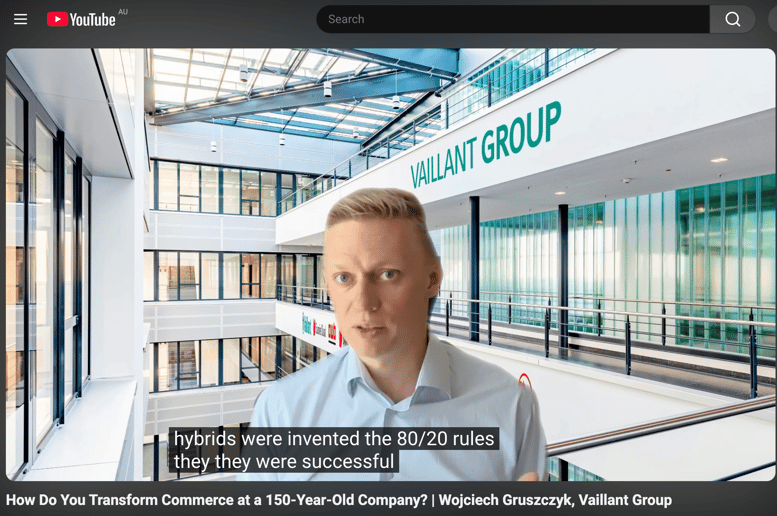
Vaillant's advantage was never only the hardware. Ask why customers choose the brand and the answers are operational: a partner network of installers you can actually call, 24/7 availability, proven quality, and — tellingly — spare-parts availability across 150 years of installed product. Access to heat, as the company put it, is a basic necessity, not a luxury. What customers buy is peace of mind.
That framing is exactly why the company refuses to let the heat pump become a commodity. Its sharpest line from the keynote: a heat pump is no longer a commodity — heat is. The product is becoming interchangeable. The outcome, delivered reliably and intelligently over years, is not. And an outcome cannot be sold from a catalog page. It has to be operated.
Heating as a Service: an IoT Value Stream
The clearest expression of that is Vaillant's move toward Heating-as-a-Service, modeled as a single Value Stream rather than a string of disconnected apps:
- IoT device. The installed heat pump streams operational data — temperature, efficiency, usage telemetry — continuously.
- Data platform. Vaillant ingests that telemetry into a shared model rather than a per-system silo.
- Autonomous logic. AI predicts maintenance before failure, tunes energy use against weather, household habits, and on-site solar, and triggers service on its own.
- Customer value. The homeowner gets a subscription with lower bills and effectively zero downtime — and Vaillant gets a continuous relationship in place of a one-time sale.
Every step depends on the previous one handing off cleanly and automatically. Break one handoff and the model collapses back into a hardware sale with a dashboard attached. That is autonomous execution doing the load-bearing work.
150 Years of Legacy, Re-Orchestrated
None of this replaces what Vaillant already built. The consumer app (myVaillant), the installer platform (myVaillant Pro), and its Partner API remain the front doors. Autonomous Commerce Execution runs beneath them, pulling their data into a shared model through a data-lake and process-mining foundation, so a decision can cross from a homeowner's app to an installer's job to a service trigger without a person carrying it. The lesson Vaillant drew for the room was blunt and worth stealing: ERP is not commerce. An ERP records what happened. Autonomous Commerce Execution decides what happens next.
How to Tell an AI-Native Commerce Vendor From a Repackaged One
Vaillant's caution for the audience was pointed: traditional SaaS commerce is aging out, and "AI-powered" is now printed on everything. If change is continuous, the platform underneath it has to be built to keep moving, and a badge on a brochure is not evidence of that. Use these as evaluation criteria, not a feature checklist:
- Does the AI act, or only advise? An agent that surfaces a recommendation still needs a human to execute it. Ask to see a process the platform completes on its own.
- Is autonomous execution native, or bolted on? If autonomous behavior lives in a separate module wired to the "real" platform, you have bought integration debt with a new label.
- Can business teams model a Value Stream without a developer? If every process change is a development sprint, your operations will always move faster than your platform's release cycle.
- Does it run on your data, in your process? The durable advantage is a model trained on your proprietary data and tuned to your workflow — not a generic capability every competitor also rents.
- Is the vendor building for what comes next? Agent-led buying is arriving whether or not the roadmap is ready for it. Ask what the platform does when the buyer is a machine.
These five criteria provide a litmus test for any shortlist; when applied to the Emporix ACE platform and its peers, they quickly separate what is authentically AI-native from what is repackaged.
From Manual Chaos to Autonomous Execution: What the Numbers Look Like
Vaillant's HaaS model shows the strategic ceiling. For the operational floor — proof that a Value Stream pays off in production today — look at how another Emporix customer, the B2B distributor ACR, orchestrated its purchase-order intake. Incoming orders arrive as unstructured PDFs attached to emails. The old process was a person reading each one and keying it into the ERP. The Value Stream turns that into five automated steps: an email trigger, AI interpretation of intent, data extraction and mapping, rule-based validation with exceptions routed out, and a clean order delivered to the ERP.
|
Purchase order intake |
Before: manual |
After: autonomous execution |
|---|---|---|
|
Who reads the order |
A person, order by order |
AI interprets and classifies intent |
|
Processing speed |
Hours to days, batched |
Under 60 seconds per order |
|
Throughput gain |
Baseline |
87% faster order processing |
|
Reliability |
Variable, error-prone |
95% success rate, exceptions routed |
As ACR's CIO Thai Vong put it: "We are building a commerce operation that can increasingly make operational decisions autonomously." That sentence is the destination Vaillant is steering toward from the opposite end of the market — one a heavy manufacturer, one a distributor, both concluding that the differentiator is the autonomous process, not the connected system. It is also, not incidentally, what a modern B2B customer portal has to do underneath the interface.

